M-Audio is a long-established professional audio equipment manufacturer from the United States. It is widely recognized in professional audio decoders, MIDI equipment, and audio systems. The brand maintains professional-grade standards for appearance quality, process accuracy, functional fit, and mass-production stability.
For a brand such as M-Audio, which serves professional studio and recording applications, the control panel is not only a core functional interface. It is also a key component that communicates professional quality and reinforces brand recognition. Its visual texture, functional compatibility, operating clarity, and assembly precision directly affect the end user’s professional experience and reflect the brand’s commitment to professional-grade manufacturing standards.
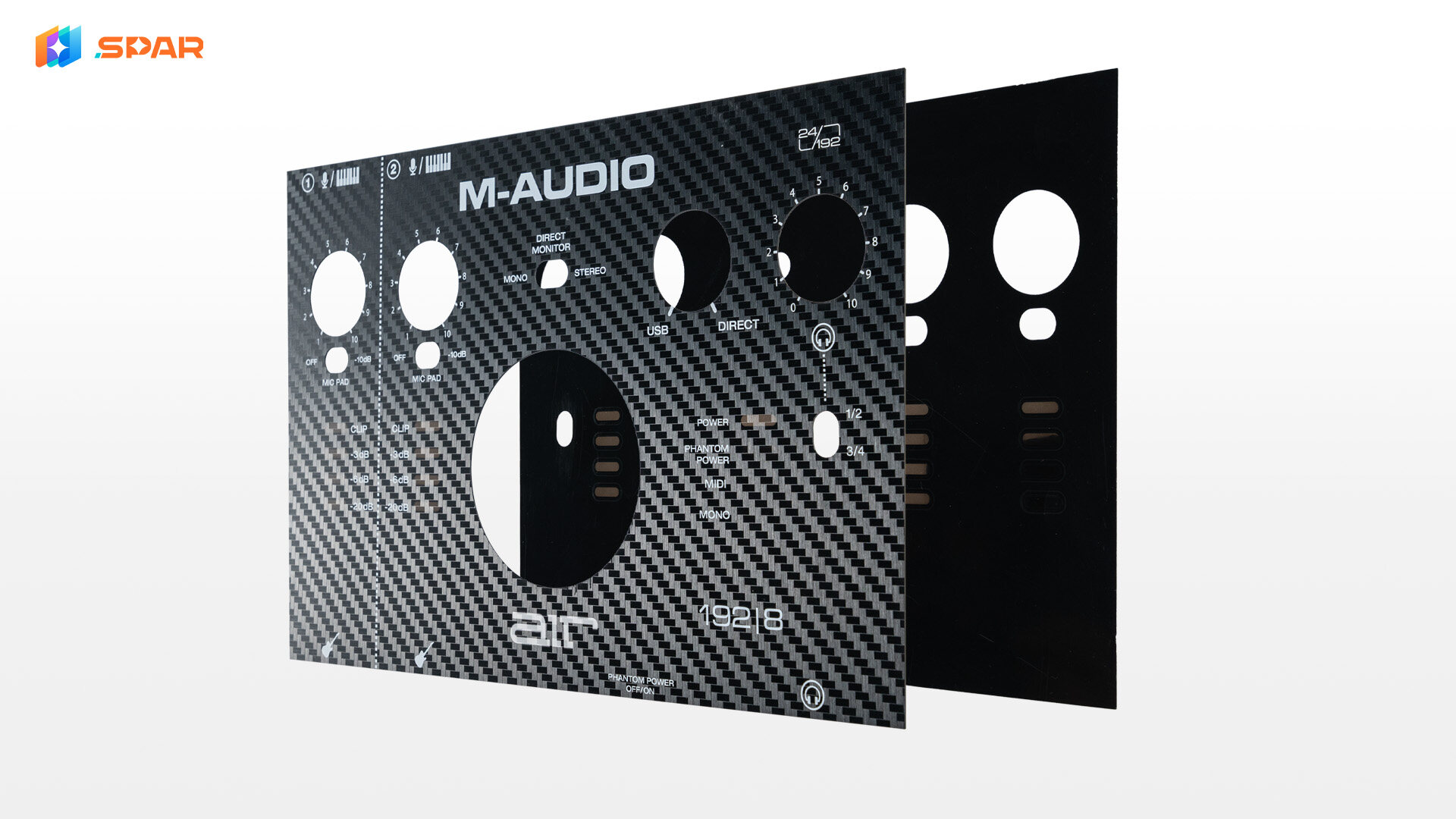
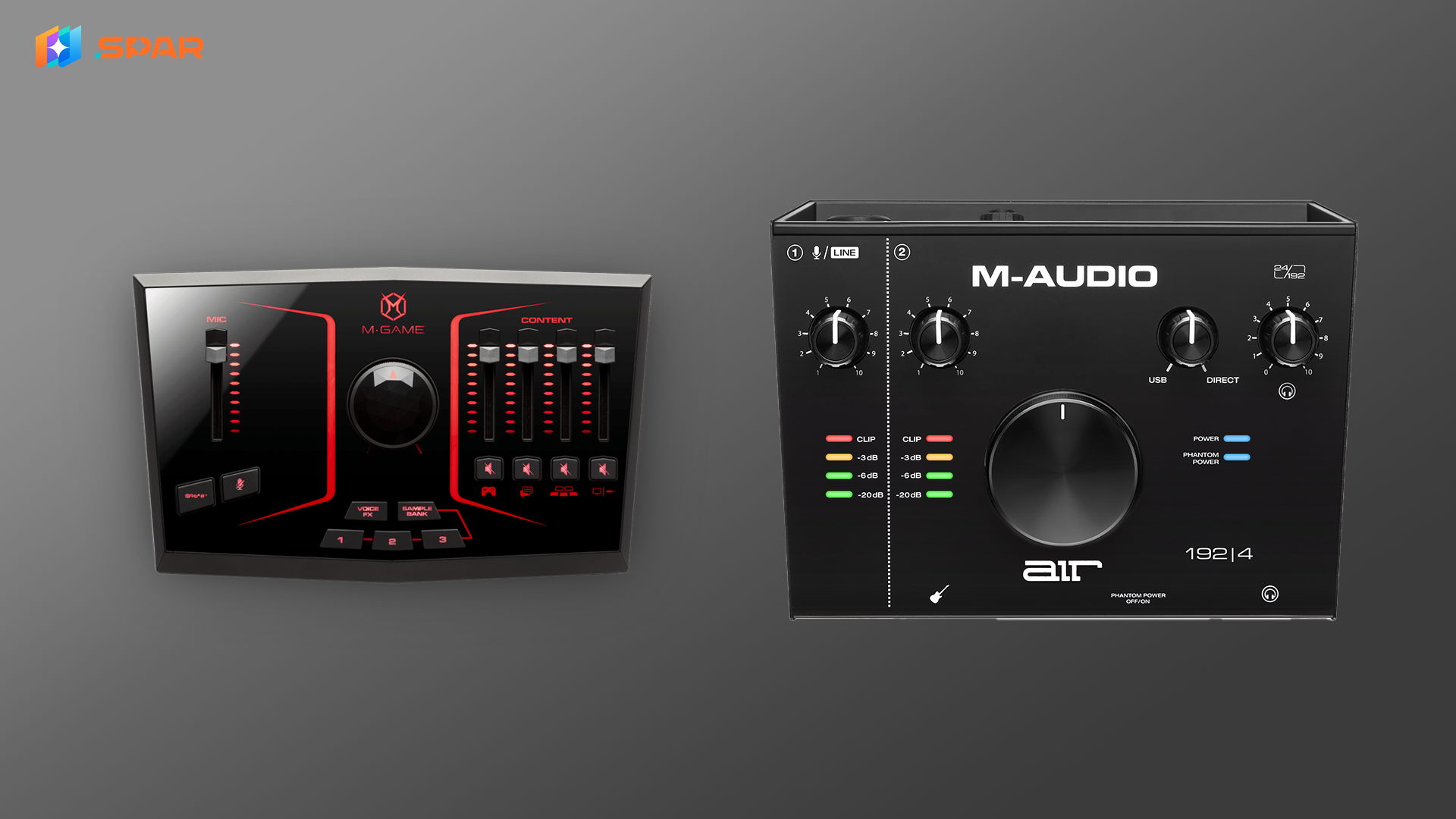
In 2019, M-Audio’s purchasing team contacted us by email to develop a custom polycarbonate control panel for the surface of its upcoming AIR 192|8 USB audio interface.
M-Audio required the panel to meet both visual and functional goals through professional manufacturing processes:
After in-depth discussion with the M-Audio engineering team, we finalized an integrated process route using a 1.0 mm high-transparency polycarbonate (PC) substrate, with UV texture transfer carbon-fiber patterning on the substrate surface, high-precision front and back screen printing, and precision CNC integrated forming. This solution achieved the expected visual texture and functional requirements.
The project had to balance the premium appearance, functional compatibility, and mass-production cost of professional audio equipment, while overcoming several key technical challenges.
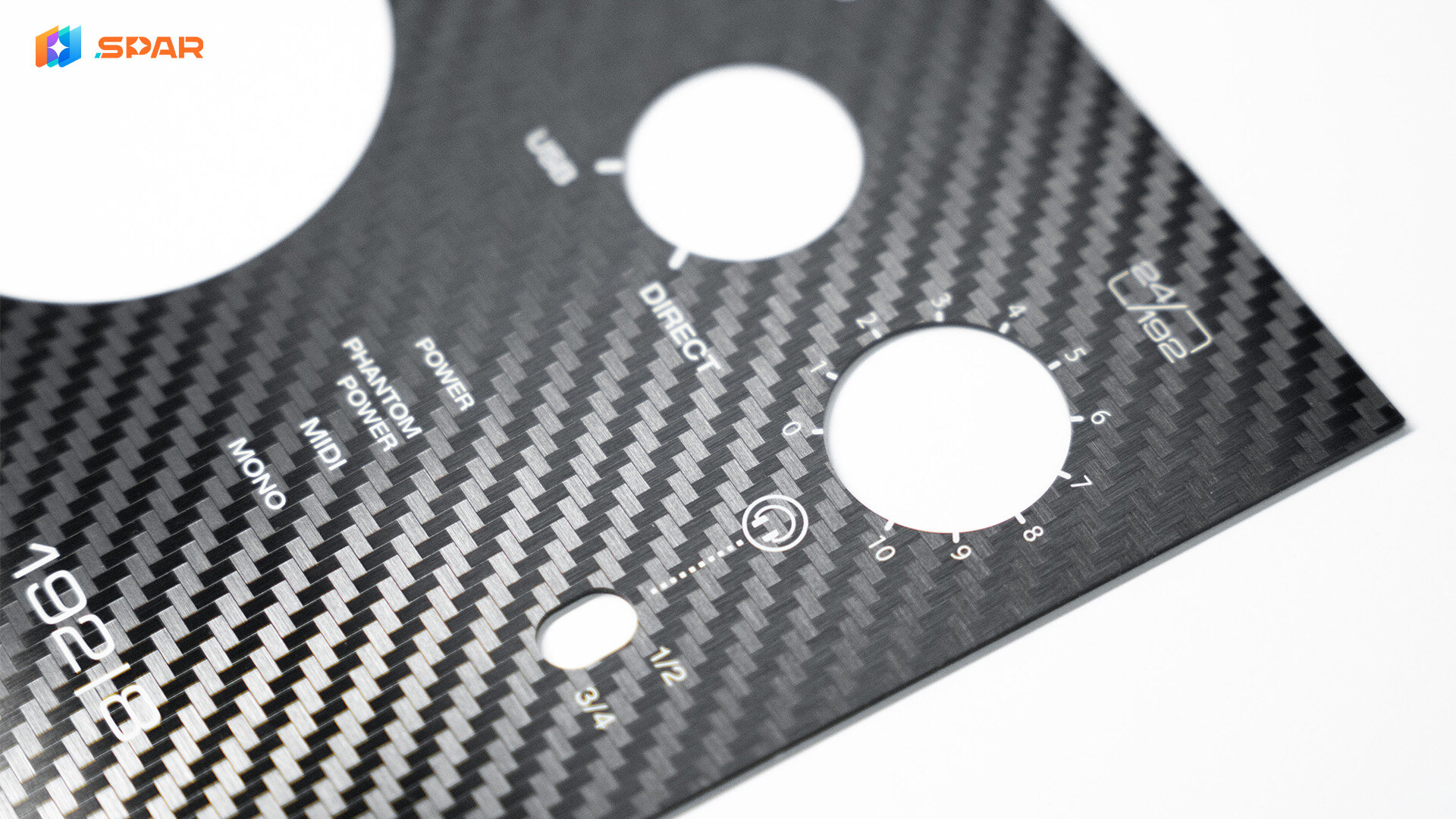
The panel surface needed to present a realistic three-dimensional carbon-fiber weave effect. Both the visual appearance and tactile texture had to come very close to native carbon fiber sheet, matching the premium product positioning of professional audio equipment. At the same time, the customer needed to control production cost and avoid the high material cost and difficult processing associated with native carbon fiber sheet.
For this reason, we selected a 1.0 mm high-transparency PC panel as the core substrate and developed a dedicated high-precision UV transfer mold for the carbon-fiber weave pattern. By optimizing the UV resin layer thickness, light-curing parameters, pressing temperature, and pressing pressure, we accurately reproduced the three-dimensional weave, matte texture, and visual depth of native carbon fiber sheet.
With a 100% opaque black ink layer as the base, the UV-transferred carbon-fiber weave achieved a 99% similarity to real native carbon fiber sheet. Compared with an expensive native carbon fiber solution, this approach significantly reduced raw material and processing costs while maintaining a premium visual effect.
The panel required dual-function screen printing on both sides. The back side needed a black light-shielding base layer with designated semi-transparent backlit areas. The light-shielding boundaries had to be precise, with no light leakage and uniform backlight display. On the carbon-fiber-textured front surface, white brand logos, markings, and functional icons had to be printed with sharp, bleed-free edges. The printed graphics needed to blend visually with the carbon fiber texture while maintaining excellent adhesion and long-term resistance to peeling and fading under frequent professional use.
To meet these combined front/back screen-printing requirements, we developed a dedicated layered printing process. On the back side, we used a “transmission first, light shielding second” reverse-printing logic. The backlit areas were first printed with special translucent ink, and then a high-opacity black ink layer was overprinted as the light-shielding layer. By tightly controlling ink thickness and registration accuracy, we eliminated light leakage and uneven transmission from the source.
On the front surface, we selected high-adhesion industrial white ink with strong compatibility with the UV-transferred texture. We optimized the screen mesh count and squeegee parameters to ensure sharp, smooth graphic edges and natural integration with the carbon fiber texture. After printing, the parts passed cross-hatch adhesion and weathering-aging tests, verifying stable ink-layer performance under long-term high-frequency use.
After surface film protection, the finished panel required CNC machining for outer-contour cutting and center functional hole machining. The cut edges had to be smooth, burr-free, and free of chipping. Dimensional tolerances across the full panel had to remain within the assembly standard so that the panel could fit accurately with the device housing and internal components.
We customized ultra-fine-tooth tungsten carbide milling cutters and optimized the toolpath and layered cutting parameters to prevent chipping and burrs during PC machining. During machining, dedicated positioning fixtures were used to secure the panel and protect the UV-transferred texture and printed graphics throughout the process. Final dimensional tolerances across the panel were controlled within ±0.05 mm, with smooth and flat cut edges that fully met M-Audio’s automated assembly standards.
The project involved several core processes, including UV texture transfer, front/back screen printing, and precision CNC cutting. All process steps had to share a unified reference, remain compatible with each other, and avoid any damage to the UV-transferred texture or printed layer.
We established a unified cross-registration reference system across the entire production process. UV texture transfer, front/back screen printing, and CNC cutting all used the same positioning coordinates, ensuring accurate alignment between each process. We also optimized the process sequence into a standardized workflow: UV texture transfer forming → front/back layered screen printing → precision CNC forming.
After each process step, the parts underwent full appearance and dimensional inspection before moving to the next operation. Dedicated protective films and fixtures were used throughout production to protect the panel surface, fully preventing damage to the UV-transferred texture and printed layer and ensuring complete finished-product appearance integrity.
Through full-process optimization and multi-process integration control, the project met all of M-Audio’s customization requirements and achieved long-term stable batch delivery. Key results are summarized below:
|
Metric |
Data |
Notes |
|
Cumulative Delivery Volume |
Over 20,000 pieces |
Total delivery quantity for this product since 2020 |
|
Cooperation Status |
M-Audio approved manufacturing partner |
Core stable qualified supplier for professional audio equipment control panels |
|
Cooperation Period |
2019 to present |
Stable mass production after successful sample validation |
|
Delivery Lead Time |
3–5 working days for sampling; 7-14 working days for mass production |
Adapted to the customer’s new product development rhythm and mass-production schedule |
|
Metric |
Data |
Notes |
|
Core Substrate |
1.0 mm high-transparency PC sheet |
Replaced native carbon fiber sheet to support the cost-reduction target |
|
CNC Forming Tolerance |
Within ±0.05 mm |
Matched the assembly requirements of the complete device |
|
Backlight Effect |
No light leakage; uniform and clear display |
Precise light shielding, fully matching the functional display requirements |
|
Screen Printing Quality |
Sharp, bleed-free edges; excellent adhesion |
Integrated naturally with the carbon fiber texture and remained stable over long-term use |
|
Authoritative Review |
All inspections passed |
Passed full inspection by M-Audio’s U.S. headquarters R&D and quality control teams |
|
Reliability Verification |
Cross-hatch adhesion and weathering-aging tests passed |
Met the long-term use requirements of professional equipment |
|
Core Process |
UV transfer carbon-fiber-like texture + front/back screen printing + precision CNC forming |
Integrated production and delivery across the full process |
|
Mass Production Yield |
Above 98.9% |
Stable data from large-volume production and long-term delivery |
From texture reproduction and cost optimization to mass-production stability, this project verified the suitability of UV-transferred simulated-texture panels for professional audio equipment. It also demonstrated Spar Panel’s comprehensive capability in multi-process integration, premium texture reproduction, and cost optimization.
For professional equipment panel projects that must balance premium visual texture, functional compatibility, and cost control, full-process control capability and mass-production consistency are the key competitive factors that win the trust of international professional brands.
For Spar Panel, this project was not only a single successful delivery. Through our deep cooperation with M-Audio, we accumulated valuable customization experience in premium-texture panels for professional audio equipment and established a standardized production and quality control system suitable for international professional brands. This foundation continues to support our future work on high-end texture-customized panel projects.
Q1: How does UV texture transfer achieve a high-fidelity carbon fiber effect while controlling production cost?
A: We developed a dedicated high-precision UV transfer mold for the carbon-fiber weave pattern and optimized the UV resin layer, light-curing, and pressing processes. This allows us to reproduce the three-dimensional texture, matte feel, and visual depth of native carbon fiber. At the same time, using PC substrate instead of expensive native carbon fiber sheet significantly reduces raw material and processing costs, balancing premium texture with cost efficiency.
Q2: Since the UV-transferred texture has a three-dimensional surface, how do you ensure screen-printing adhesion and clarity?
A: We use high-adhesion industrial ink that is highly compatible with the UV-transferred texture. By optimizing the screen mesh count, squeegee parameters, and curing process, we ensure sharp, bleed-free printed edges and natural integration with the carbon fiber texture. The printed layer is verified through cross-hatch adhesion, scratch resistance, and aging tests to ensure long-term resistance to peeling and fading.
Q3: How do you achieve precise light shielding in the backlit areas and avoid light leakage?
A: We use a layered back-side screen-printing process. The designated backlit areas are first printed with special translucent ink, followed by precise overprinting of a high-opacity black light-shielding layer. By strictly controlling ink density and registration accuracy, we prevent light leakage from the source, ensuring uniform and clear display in the backlit areas while keeping non-backlit areas fully opaque.
Q4: For a panel involving multiple processes, how do you keep all steps accurately aligned without damaging the surface texture?
A: We establish a unified cross-registration reference system across the entire process. UV transfer, screen printing, and CNC cutting all share the same positioning coordinates to ensure accurate alignment. We also optimize the production sequence and use dedicated protective films and fixtures throughout the process. After each step, full appearance inspection is performed to avoid damage to the surface texture and printed layer.
Q5: How does the screen-printing process for PC panels support both front/back printing and complex functional requirements?
A: We customize a layered screen-printing solution for front/back printing. Different inks are selected according to the front-side marking requirements and back-side backlight functions. The color sequence and printing parameters are optimized, and a unified positioning reference is used to control registration accuracy. This ensures accurate front/back alignment while balancing marking clarity, light shielding, and long-term stability.
Q6: What other UV transfer textures can be customized?
A: In addition to the carbon-fiber-like weave texture mentioned in this case, we can also customize CD patterns, brushed textures, laser effects, and other decorative textures. Contact us with your product requirements, and we will recommend suitable options.
Spar Panel is a source manufacturer in China specializing in custom acrylic and polycarbonate graphic overlays. We provide long-term, stable support for international brands with consistent delivery and reliable product quality.
If you need carbon-fiber-like texture panels, other premium UV-transferred decorative panels, or professional audio equipment control panels, please contact us and share your drawings. We will provide a customized quotation and rapid prototyping service.


