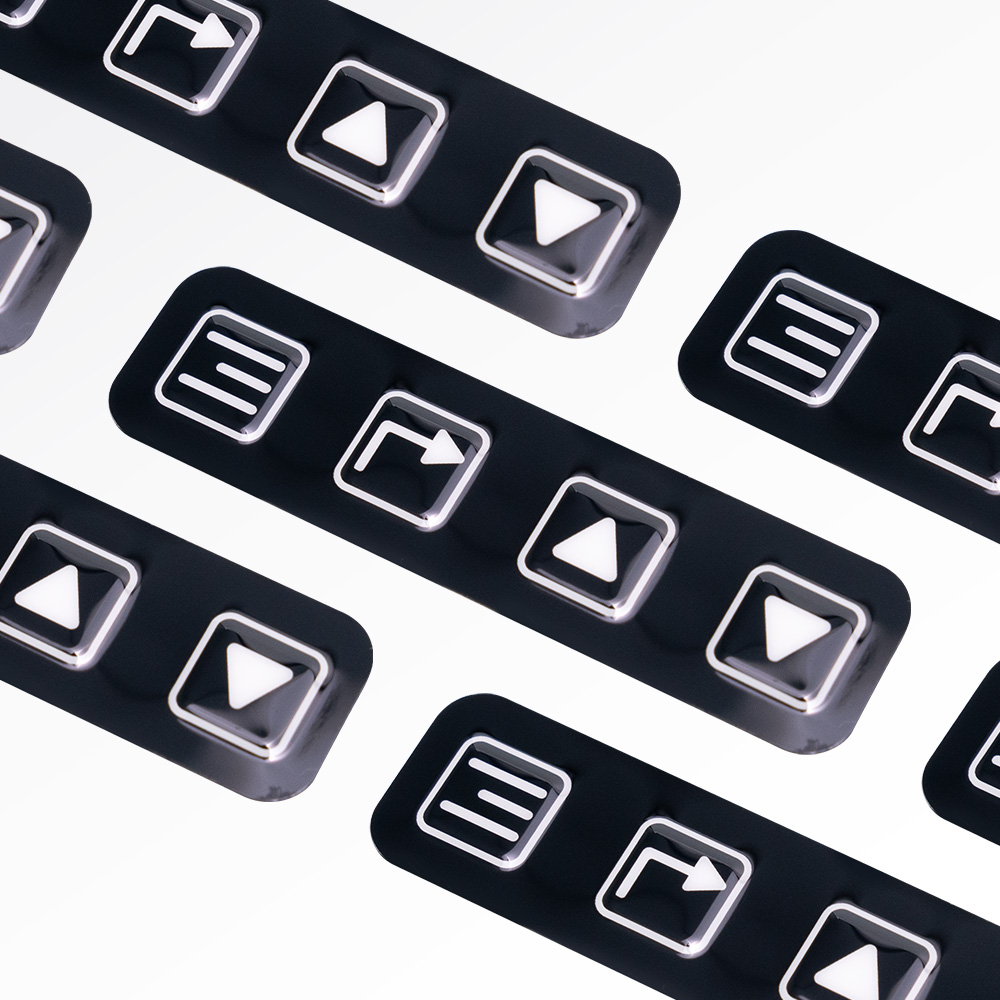
When designing membrane switch panels for household appliances, industrial control systems, medical & health devices, and similar products, engineers often face the same user-interface dilemma: capacitive touchscreens offer no physical feedback and are less reliable in demanding environments; standalone mechanical buttons provide strong tactility but have poor sealing and more complex structures; flat printed buttons are fully sealed but provide no clear confirmation during operation.
Emboss Overlays appear to solve these problems well, but designers often encounter major challenges during prototyping and mass production, including cracking, weak rebound, inconsistent tactile feel, low yield, ink-layer peeling, and insufficient service life.
An embossed button is a precision-formed raised feature created on flat PET or PC film through localized thermoforming. It combines physical tactile feedback with a fully sealed surface, making it one of the most widely used interface solutions for household appliances, industrial equipment, and electronic devices.
The comparison below shows how emboss overlays perform against other mainstream interaction methods.
|
Feature |
Embossed Button (Membrane Type) |
Flat Printed Button |
Standalone Mechanical Button |
Capacitive Touchscreen |
|
Tactile Feedback |
Clear tactile feel and travel, suitable for blind operation |
None, visual feedback only |
Excellent, but with longer travel and a more complex structure |
None, usually relies on vibration or sound for feedback |
|
Sealing Performance |
Excellent, fully sealed structure with strong dust and water resistance |
Excellent |
Poor, requires panel openings and is more vulnerable to dust and water ingress |
Excellent, integrated into the panel surface |
|
Appearance & Design |
Slim profile, compatible with backlighting, flexible in design |
Slim flat profile |
Raised structure with more design limitations |
Modern full-flat appearance |
|
Durability |
High, PET: 500,000–1,000,000 cycles; PC: 1,000,000–3,000,000 cycles. |
High, depending on surface treatment |
Medium, as the mechanism can age or fail because of dust ingress |
High, but the screen surface is easier to scratch and more costly to maintain |
|
Cost |
Low, with strong overall cost performance |
Low |
High, due to assembly complexity and labor cost |
Medium |
|
Best Fit Scenario |
Products that need clear tactile feedback, good sealing, and a thin profile |
Simple, low-cost products |
Professional equipment with extremely high tactile requirements |
Smart devices with large screens and layered menus |
For relevant process details, please check our process service column.
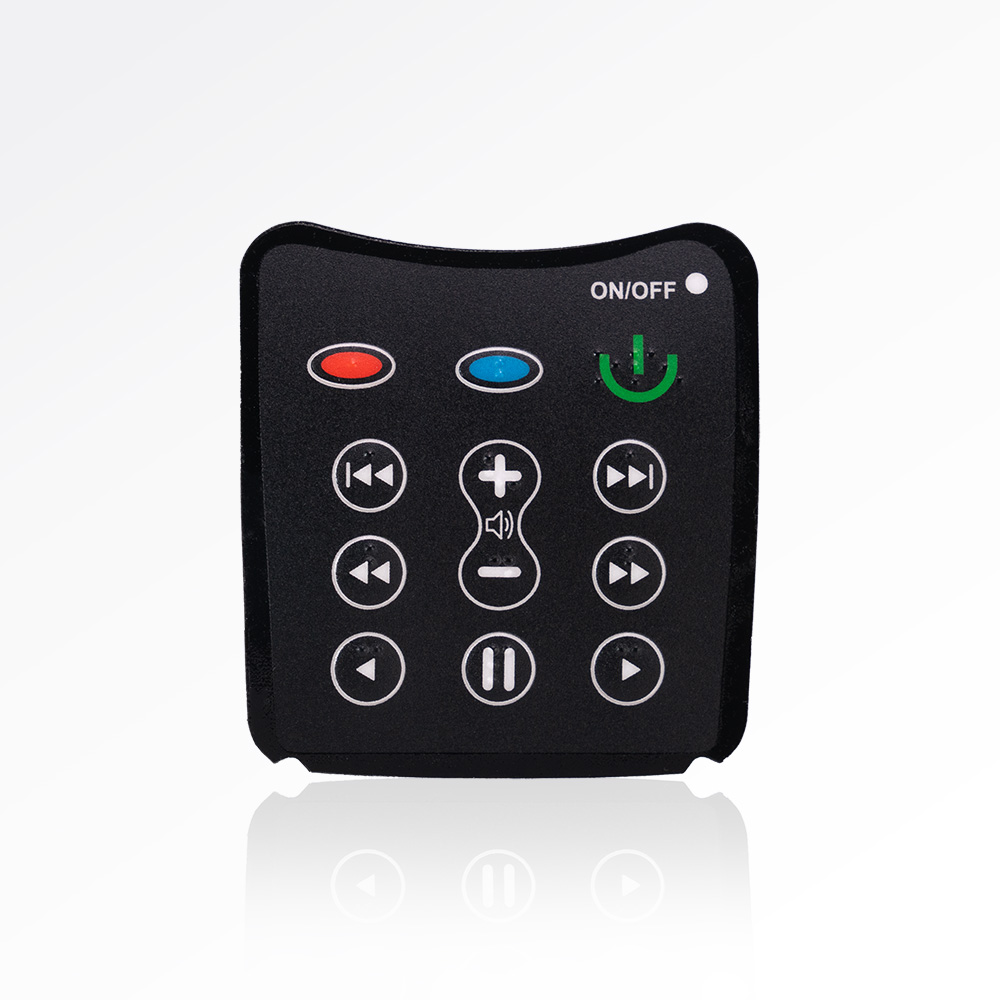
The essence of emboss overlays lies in the precise biaxial thermoforming of polymer film. The process can be understood in three key stages:
When thermoplastic materials such as PET and PC are heated above their glass transition temperature (Tg), their molecular chain mobility increases significantly. The material shifts from a hard, brittle glassy state to a soft, elastic state that can be formed more easily. PET typically has a Tg of about 70–80°C, while PC typically has a Tg of about 145–150°C.
Within a tightly controlled temperature range, pressure is applied locally through a precision mold so the film stretches in two directions while maintaining reasonable thickness uniformity. This forms the required raised dome or platform structure. Temperature, pressure, and dwell time must be carefully matched: insufficient pressure can result in incomplete embossing and weak rebound, while excessive pressure or excessive heat can cause thinning, whitening, or even cracking.
While the forming pressure is maintained, the material is cooled below Tg. The polymer chains are then fixed in the new shape, giving the embossed structure permanent shape memory.
The mold is the core of the thermoforming process and directly affects the tactile feel, dimensional accuracy, and service life of the embossed button.
The screen-printed membrane panel is fixed accurately on the thermoforming table through pinhole alignment so the printed graphics, icons, and emboss positions stay aligned, preventing offset after forming.
After the dwell stage, the part is cooled while the mold remains closed so the embossed shape is fully set before demolding. After release, button height, dimensions, appearance, and rebound performance are inspected, and any defective parts are removed.
Membrane switch panels with embossed buttons are typically mounted over a PCB fitted with metal domes. The embossed area acts as the button cap, while the metal dome acts as both the switch and the spring. Together they form a complete tactile button structure. The embossed button sits on top, the metal dome is in the middle, and two separated circular contacts sit below on the PCB.
The forming result, tactile feel, and service life of an emboss overlay depend heavily on substrate selection. For most embossed-button applications, Spar Panel recommends PET as the preferred material. The comparison below summarizes the main differences between the common options.
|
Material |
Core Advantages |
Typical Applications |
Limitations |
|
PET (Polyester Film) |
Best overall balance of hardness,rebound, weather resistance, printability, and cost |
Mainstream choice for embossed buttons in home appliances, consumer electronics, and industrial control panels |
Its ultimate forming capability in ultra-thin applications is slightly lower than that of PC, and it is not recommended for long-term high-temperature use |
|
PC (Polycarbonate Film) |
Good toughness and impact resistance, with advantages in temperature resistance and stretch-forming capability |
Panels used in applications with more demanding structural or environmental requirements |
Higher cost than PET, higher printing-process requirements, and generally lower yield and rebound feel in mass production |
Supplementary note: Acrylic (PMMA) is too brittle for biaxial stretch forming and is therefore not suitable for embossed button production.
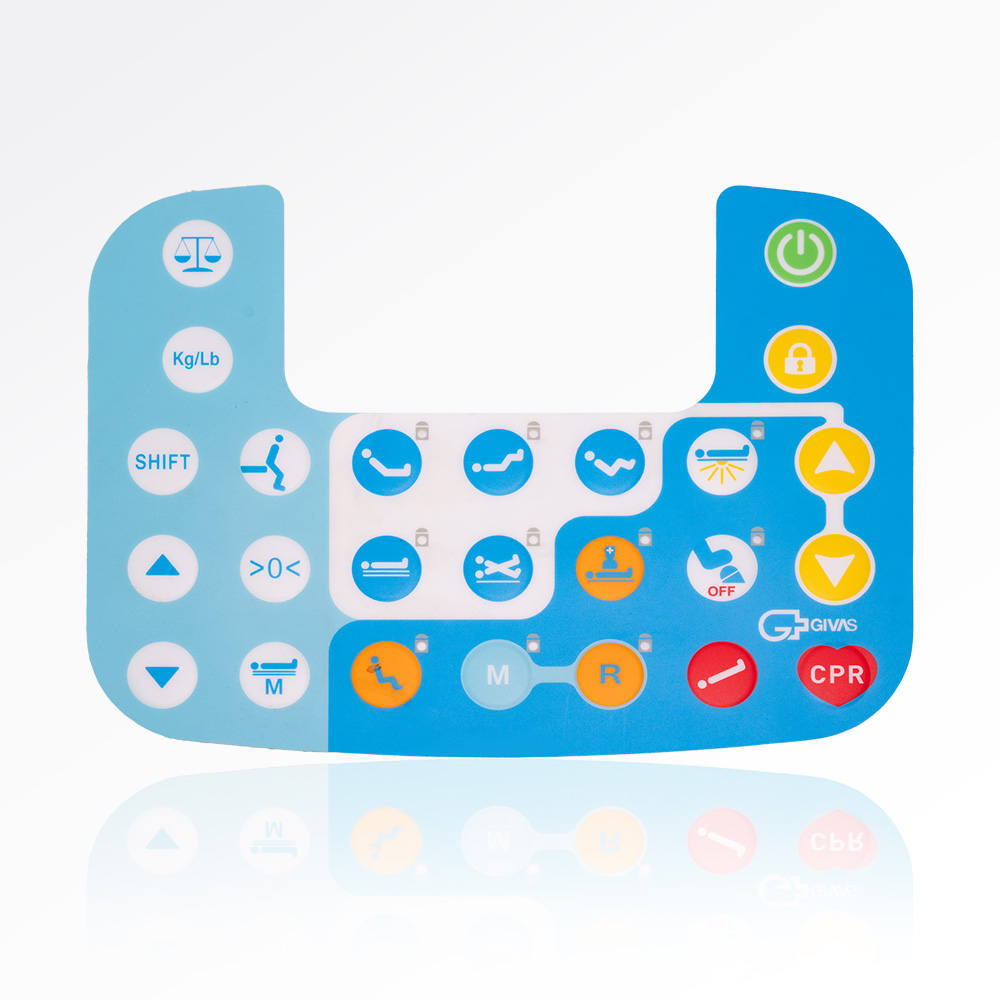
Emboss height is limited by button diameter, material thickness, and forming conditions. We recommend keeping button height at or below 2.0 mm. Beyond this range, forming difficulty and manufacturing cost rise significantly, while the risks of thinning, whitening, and root cracking also increase.
Circular emboss overlays distribute stress more evenly during forming, create the least material-flow resistance, and generally offer the highest forming yield. From a fatigue-life standpoint, they also provide the longest service life because they avoid the sharp-corner stress concentration found in many other shapes.
After quality testing, Spar Panel found that circular PET button-panel structures maintained stable operation for more than 100,000 press cycles.
Other shapes can also be used, but their durability is usually lower because stress is distributed less evenly. In square embossed buttons, for example, the corners create stress concentration during use, and peak stress in some areas can exceed that of a circular structure by more than three times. This can lead to fatigue cracking and reduced service life.
Spar Panel can also produce raised structures in non-circular shapes. In these cases, we recommend a fillet radius of at least 0.5 mm and, where possible, a reduced button height to improve service life.
6. How Does Spar Panel Provide Reliable and Durable Embossed Button Panel Solutions for Global Customers?
As a well-known household medical & health device brand in China, YUWELL Medical maintains strict requirements for product accuracy, operating reliability, and long-term stability. As a supporting manufacturer for YUWELL Medical equipment, Spar Panel customizes PET display panels with embossed buttons for its home blood pressure monitor product line. With an integrated process that combines back screen printing, thermoforming, adhesive lamination, and CNC precision cutting, we provide a panel solution with clear display performance, comfortable operation, and accurate assembly.
This case focuses on a home blood pressure monitor panel project customized for YUWELL Medical. The product is used in the front operating and display area of the monitor. The core process includes back screen printing on a 0.188 mm ultra-thin PET substrate, embossing buttons to a height of 0.8 mm, adhesive lamination, and integrated CNC cutting. The panel had to meet three requirements at the same time: clear display readability, comfortable button operation, and accurate assembly in the final product.
To meet the safety and reliability standards of household Medical & Health Devices, YUWELL Medical set four strict requirements for this project. These centered on ultra-thin substrate processing, clear visual presentation, embossed-button tactility, and composite-process accuracy.
Ultra-thin PET Substrate Forming Adaptation Requirements
Based on years of panel-processing experience and the core challenges of this project, we developed a closed-loop production solution covering ultra-thin substrate adaptation, high-precision screen printing, accurate embossed-button forming, and controlled integration of the downstream processes.
For the 0.188 mm ultra-thin PET substrate, we developed a high-precision thermoforming mold and optimized the hot-press temperature, forming pressure, and dwell time. A step-by-step forming approach was used to disperse stress and avoid tensile deformation and cracking. Button height was controlled within 0.8 mm ±0.15 mm so all three buttons remained uniform. We also optimized the button curvature to achieve comfortable feel and stable rebound in high-frequency household use.
We established a shared cross-positioning reference system for both the printing and forming processes. The screen-printing film and forming mold used the same positioning coordinates, ensuring that the embossed buttons aligned accurately with the printed button marks and that positional deviation stayed within ±0.2 mm. After the first piece was produced, button height, position, and tactile feel were inspected before sample approval and sealing by the customer. During production, sampling inspections were carried out throughout the process to ensure batch consistency.
We selected low-odor 3M adhesive and used automatic lamination equipment to control tension and flatness, ensuring full bonding to the back of the PET without bubbles, overflow, or warping. During CNC cutting, special fixtures, optimized toolpaths, and proper tool selection prevented damage to the embossed area and printed layer. Final contour and opening tolerances were controlled within ±0.05 mm to meet the accuracy requirements of YUWELL Medical's automated assembly line.
Process and Mass Production Achievements: Through full-process optimization, we overcame the main challenges of ultra-thin PET forming, high-precision screen printing, and precise alignment, meeting YUWELL Medical's process requirements. The embossed buttons showed uniform height, comfortable tactile feel, and stable rebound. The printed graphics remained clear and readable, CNC accuracy matched the assembly requirements, and mass production yield remained stably above 99%, supporting long-term batch delivery.
Long-Term Customer Recognition: The final products passed the full audits conducted by YUWELL Medical's R&D and quality control teams for product quality, operating reliability, and assembly accuracy. With proven embossed-button process capability and stable quality control, Spar Panel has become a long-term qualified supplier for YUWELL Medical's home blood pressure monitor product line and continues to provide customized panel solutions.
|
Parameter |
Recommended Range |
Common Value |
Process Impact |
Risk Warning |
|
Button Height |
0.5–2.0 mm |
0.5–1.0 mm |
Affects tactile recognition and button feel |
The maximum achievable height depends on button diameter |
|
Side Wall Angle |
60°–85° |
70°–75° |
Larger angles improve forming stability and demolding smoothness |
Below 60°, forming becomes more difficult and yield may drop by 20%–30% |
|
Root Fillet (R) |
≥0.5 mm |
0.5–1.0 mm |
Helps disperse stress and extend service life |
If there is no fillet or R < 0.3 mm, stress concentrates at the corner and service life can drop by more than 50% |
|
Material Thickness
|
0.125–0.188 mm |
0.125–0.188 mm |
Affects both maximum emboss height and rebound performance |
Below 0.1 mm, support is insufficient; above 0.188 mm, forming pressure increases significantly |
|
*For most membrane-switch embossed buttons |
||||
A good design must also meet practical manufacturing requirements. Spar Panel, a professional China OEM custom manufacturer, provides standardized DFM (Design for Manufacturability) review services to help global customers identify design risks early and ensure stable mass production. The core submission requirements and review points are listed below.
|
Submission Item |
Format Requirement |
Required Content |
Purpose |
|
2D Engineering Drawings |
PDF/DWG |
Button height, top diameter, bottom diameter, root fillet radius, material thickness, dimensional tolerances |
Basis for mold machining and dimensional inspection |
|
Printing Design File |
AI/CDR |
Vector artwork, clearly marked color codes (Pantone or CMYK), light-transmitting and opaque areas |
Used for screen-printing plate making and alignment between graphics and emboss positions |
Q1: What is the typical service life of an embossed button?
A: Embossed buttons made from PET typically last 500,000 to 1,000,000 cycles. PC offers better fatigue resistance and can reach 1 to 3 million cycles, depending on operating force, frequency, ambient temperature, and chemical exposure.
Q2: What texture and finish options are available for embossed buttons?
A: Gloss and matte are the standard recommendations. For other surface textures, please consult Spar Panel engineers for evaluation.
Q3: Can the embossed area be backlit?
A: Yes. This is a common process in high-end panel applications. By selecting high-transmission PET or PC and combining opaque solid inks with semi-transparent inks, localized backlighting can be achieved.
Q4: What are the maximum height and minimum diameter that can be achieved for embossed buttons?
A: These limits depend on both material behavior and mold accuracy. As a practical guideline:


