Introduction: Custom control panel labels are not decorative extras; they carry device identity, function cues, scale marks, and notice text that operators need at a glance.
As an equipment designer, you already know that a control panel has to work under rougher conditions than the design studio suggests. Operators read it under bright shop lights, with gloves or oily hands, in a hurry, and sometimes after years of hard use. The labels on that panel are the quiet part of the interface: they tell an operator which machine this is, what each control does, what value is set, and what to pay attention to. Understanding the function types behind custom control panel labels makes it easier to decide what to print, where to place it, and what kind of construction will keep it readable over the life of the product.
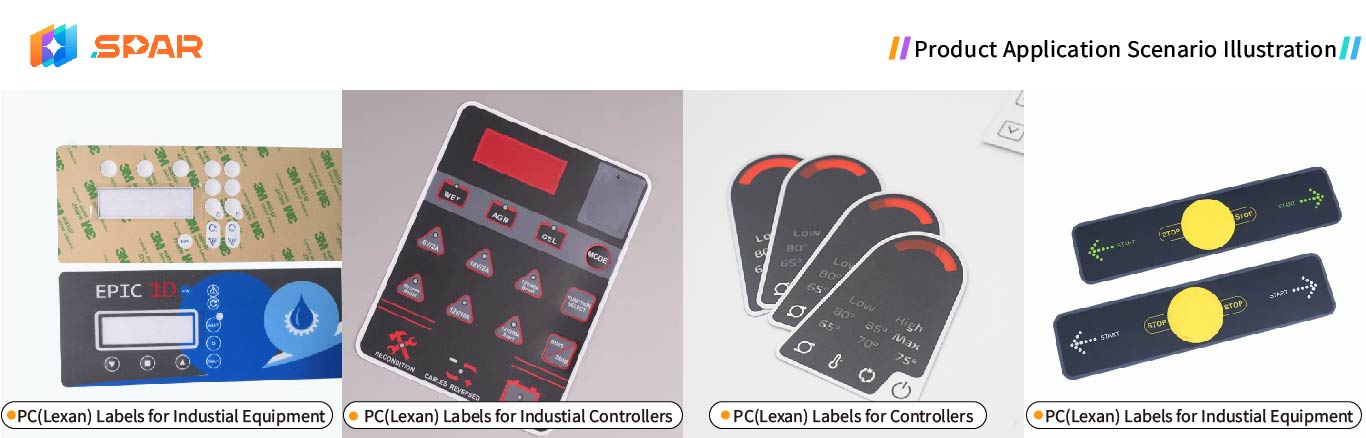
Walk through a real machine room and watch how an operator behaves. She does not open the manual first; she looks for the pump that is making noise, checks that the correct unit is selected, reaches for the button that starts a cycle, and glances at a pressure scale to confirm the setting. Each of those actions depends on information carried by the panel itself. A label answers questions that would otherwise require training, memory, or another person. When labeling is done well, the interface explains itself in seconds. This is also why panel labeling questions often come up late in a design project. The mechanical layout of switches and displays gets settled first, and only then does someone ask how operators will tell one button from another. At that point the designer needs to know which messages are truly essential. Control panel labels handle a surprisingly small set of information jobs: identifying the machine, describing controls, showing scale values, and delivering short reminders. Everything else may belong in the manual or on a larger informational plate. Keeping the label jobs limited keeps the panel fast to read. The environment around industrial panels makes readability a real constraint, not a cosmetic preference. Glare from ceiling fixtures, oily fingerprints, scratched surfaces, and worn edges all work against the printed text. A label that looks clear in a drawing may fail in the field if the construction, surface finish, and text contrast are not chosen with those conditions in mind. That is why the material and the print process matter as much as the wording itself.
When you look at a production machine, the labels on its panel usually fall into four roles. They answer four questions: Which unit is this? What does this control do? What value is it set to? Is there anything I need to remember? These roles often overlap on one label, but separating them helps designers decide the content, size, and placement of each printed element.
In practice, these four jobs combine naturally. A compressor panel may carry a device ID on the top edge, a function label beside each switch, a scale label around the pressure dial, and a ventilation notice near the access door. Designing labels by function keeps the hierarchy consistent: identification is usually largest, function cues stay close to the control, scales align exactly with the adjustment point, and notices sit where the operator is most likely to look before acting. Whatever the role, the information on a label must be true. Regulatory guidance in the United States, including the Federal Trade Commission's advertising and marketing standards, expects claims to be honest and not misleading. The same logic applies to the words and icons printed on a control panel.
Once the label functions are defined, the physical form of the label has to serve them. Polycarbonate (PC) stickers are a common choice for these roles because the material combines the print carrier, protective surface, and adhesive in one part. A PC label can be screen printed with icons, logos, and scale lines in one pass, then die-cut to the final outline. Custom screen printing works well for solid colors, crisp text, and clean graphics, which are exactly what control panel labels need. The printed layer is part of the finished PC part rather than a separate paper coating, so the graphic holds up better when the surface is wiped or scratched. Readability comes from surface treatment as much as from print quality. A PC sticker can be finished with anti-glare to reduce reflections in bright workshops, or with anti-fingerprint to stay clear after repeated handling. The material stays flat when properly applied, so scale lines keep their position relative to the control. For mounting, the adhesive backing lets a designer place identification and function labels directly onto the panel surface, without drilling holes or adding fasteners. A product line such as the custom polycarbonate stickers that Spar Panel makes for industrial equipment includes printed graphics, logos, scale marks, and adhesive backing in the same item, which is a practical example of this all-in-one construction. Long-term fit is where the label form starts to matter in daily use. Industrial panels get hit, wiped, and exposed to temperature swings. A sticker that curls at the edge can hide a scale tick or make a notice unreadable; one that cracks around a screw hole loses the exact position needed for a scale. A PC base helps the label stay whole and stay flat, so the printed information keeps its place. The label will not last forever, but PC gives it a longer working life than paper and a more forgiving mounting process than a rigid metal plate.
Control panel labels exist to carry specific information, not to decorate a machine. Grouping them into device identification, function indication, scale marks, and notice text gives designers a clear way to plan a panel. Each role has its own placement logic, text size, and durability needs. PC stickers are a fitting carrier because they bring print quality, surface options, and adhesive mounting into one part. Whether it is called a label, a sticker, or a custom control panel overlay, the operator's questions stay the same. Start with those questions, then choose the material, finish, and production approach that will keep the answers readable.
A:Custom control panel labels serve four main functions on industrial equipment: device identification, function indication, scale marks, and notice text. Device identification tells the operator which unit is in front of them; function indication explains what a switch or indicator does; scale marks turn the panel into a readable measuring point; and notice labels deliver short operational or safety-related messages. Designers often combine several of these on one label, but each role answers a different operator question.
A:Scale labels put a printed measuring scale directly at the adjustment point, so an operator can read a position, pressure, or flow value without opening the panel or checking a separate display. A clear scale has tick marks that match the knob or slider position, numbers spaced for quick reading, and enough contrast to stay visible in low light or glare. Because the operator uses the label as a ruler, line accuracy and print definition are essential in this type of label.
A:Polycarbonate stickers are used instead of paper because they keep printed information readable under industrial conditions. PC resists cracking and tearing, so the label survives bumps, wiping, and tool contact; it stays flat at the edges, so scale marks and notice text are not hidden by curling; and the surface can be finished with anti-glare or anti-fingerprint options to preserve readability in bright work areas. Paper labels tend to smear, tear, and lift, which makes them a weaker carrier for identification and scale information.
Custom Polycarbonate (Lexan) Stickers for Industrial Equipment


