Display windows do more than cover a screen or indicator. Their optical appearance affects how clearly the information behind the panel can be seen, how much of the internal structure remains visible, and how the equipment looks when the display is turned on or off.
Clear, tinted, and translucent windows control light in different ways. A clear window prioritizes direct visibility. A tinted or smoked window reduces or changes the visible light passing through the window while still allowing the display to be seen. A translucent window diffuses transmitted light, making it more suitable for illuminated areas where a sharp view of the components behind the panel is not required.
These terms describe different optical characteristics rather than fixed universal grades. The final effect still depends on the material, color, haze, light transmission, display brightness, and complete panel structure.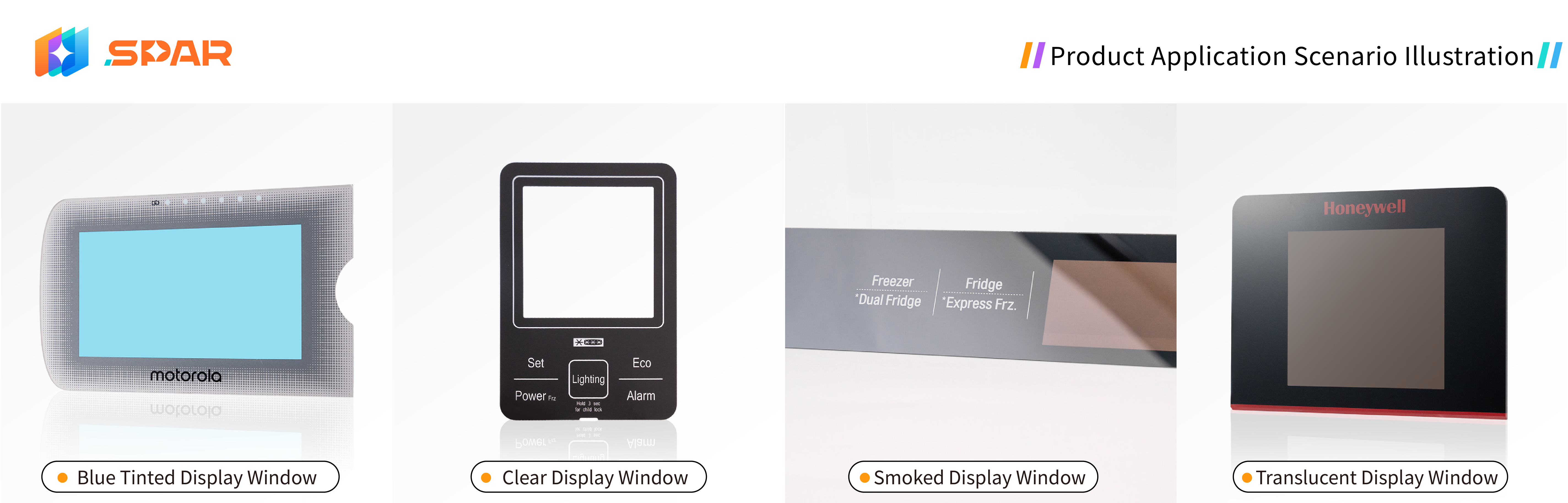
|
Window Type |
Main Visual Effect |
Typical Use |
Main Design Consideration |
|
Clear |
Provides a direct view through the window |
LCDs, screens, meters, detailed displays |
Display clarity, reflections, surface finish |
|
Tinted / Smoked |
Darkens or colors the view while maintaining transparency |
Dark equipment interfaces, status displays, integrated display areas |
Tint level, display brightness, ambient light |
|
Translucent |
Diffuses transmitted light and reduces direct visibility through the window |
Indicators, illuminated symbols, diffused light areas |
Haze, diffusion, brightness, image definition |
The best option depends on what needs to remain visible and how the display or indicator should appear in the finished equipment.
A clear display window is generally the most straightforward option when the user needs to see detailed information directly through the panel.
LCD text, numbers, graphics, meters, and other detailed display content usually benefit from a window that introduces as little intentional diffusion as possible. This helps preserve the definition of the image behind the panel.
A clear window does not mean that surface appearance should be ignored. A smooth glossy surface can provide high visual clarity, but reflections from overhead lighting, windows, or surrounding objects may become more noticeable.
Where reflection control is important, the surface finish can be evaluated separately from the basic transparent window structure.
The key principle is simple:
A clear display window is usually preferred when direct visibility and image detail are more important than hiding the components behind the panel.
A tinted display window remains transparent to varying degrees, but it reduces or changes the visible light passing through the material.
Dark gray, smoked, or other tinted effects can make the display area blend more closely with the surrounding equipment surface when the screen or indicator is turned off. When the display is illuminated, the information behind the window can still remain visible if the tint level and display brightness are suitable.
This makes tinted windows useful when equipment designers want to combine display visibility with a darker or more integrated exterior appearance.
However, a darker window is not automatically better. Increasing the tint can also reduce the amount of visible light reaching the viewer. The final result therefore depends on the relationship between:
A tinted window may also contribute to a dead-front appearance, where the display area becomes less visible when it is not illuminated. However, tint alone does not determine the complete dead-front effect. Printing structure, background color, display brightness, and the complete panel design also influence the result.
A translucent display window behaves differently from a tinted transparent window.
Instead of mainly reducing the amount of visible light, a translucent area scatters the transmitted light. This makes objects or detailed graphics behind the window less sharply defined.
That effect can be useful for status indicators, illuminated symbols, light bars, or other areas where the objective is to show light rather than allow the user to see a detailed image behind the panel.
For example, a translucent area can help soften the appearance of an LED or create a more diffused illuminated region.
The same diffusion that can improve the appearance of an indicator may reduce the clarity of small text or detailed LCD graphics. A translucent window is therefore not normally selected when the main requirement is a sharp direct view of a detailed display.
A translucent window is more suitable when light diffusion is more important than image clarity.
Tint, haze, and light transmission are related to the visible result, but they do not describe the same thing.
Tint describes the color or darkening effect of the window.
Haze relates to how much transmitted light is scattered, which can affect how clearly objects are seen through the window.
Light transmission describes how much light passes through the material or finished window structure.
These properties should not be treated as interchangeable.
A dark-tinted window can still provide a relatively clear view through the material. A lightly colored translucent window may scatter the image strongly. Two windows with a similar visible color can also behave differently when placed over the same display.
For custom equipment, the required visual effect should therefore be confirmed using the actual material specification or physical sample rather than relying only on terms such as "dark," "smoked," or "semi-transparent."
The same display window can produce different visual results when used with different screens, LEDs, or lighting conditions.
Display brightness, indicator color, the distance between the display and the window, ambient light, viewing angle, tint, and haze can all influence what the user sees.
For this reason, the window should not be evaluated as an isolated plastic component when the final display appearance is important.
A tinted window that works well with a bright display may make a lower-brightness display more difficult to read. Similarly, a translucent area that produces a smooth indicator effect with one LED arrangement may look different with another lighting structure.
The complete display and window combination should therefore be considered during sample confirmation.
Where possible, display window samples should be evaluated with the intended display, indicator, or light source.
The sample should be checked both when the equipment is illuminated and when it is turned off.
Useful review points include:
This type of sample review provides more useful information than judging the window material by itself.
For a custom display window or lens cover, the drawing should define the required size, shape, openings, and installation structure.
It is also useful to provide:
If a specific visual effect is required, a reference sample or target appearance can often communicate the requirement more clearly than general descriptions such as "dark" or "semi-transparent."
Spar Panel can manufacture custom display windows and lens covers in acrylic, polycarbonate, PET, and other suitable plastic structures according to customer drawings and project requirements.
No. A tinted window normally remains transparent to some degree while reducing or changing the visible light passing through it. A translucent window scatters light and reduces the clarity of objects viewed through the material.
A tinted window can contribute to a dead-front appearance, but the final effect depends on the complete panel structure. Tint, printing, background color, display brightness, and ambient lighting should be considered together.
Clear or suitably tinted windows are commonly considered when detailed LCD information needs to remain readable. The final choice should still be evaluated according to display brightness, ambient lighting, surface reflection, and the required equipment appearance.
Clear, tinted, and translucent display windows serve different visual purposes.
Clear windows prioritize direct visibility and image definition. Tinted windows can reduce the visibility of internal components while maintaining a transparent viewing path. Translucent windows diffuse transmitted light and are better suited to illuminated areas where a sharp view through the window is not required.
The appropriate option should be confirmed together with the actual display, lighting conditions, panel structure, and required appearance.
For custom display windows and lens covers, Spar Panel can manufacture parts according to customer drawings, material requirements, surface finishes, and intended light-transmission effects.